test-tracker → test-designer → test-debugger → test-executor. A pipeline of specialized AI agents inside VSCode. Runs in your cloud. Your LLM keys stay with you. You ship runnable Robot Framework — not black-box scripts.
Four specialized AI agents, one VSCode-native environment. You steer — they design, run, debug, and file bugs. Every step produces a reviewable artifact in your workspace.
test-tracker
Knows what's covered, what's flaky, what's next. Orchestrates the pipeline by picking the next scenario to automate — from your TestRail, Jira, Zephyr, or suite state.
→ Coverage & state view
test-designer
Turns a TestRail ticket, Jira story, or plain-English spec into a Robot Framework test. Structured, readable, runnable.
→ Runnable .robot file
test-debugger
Runs the test, inspects failures, self-heals locators, proposes diffs. Pauses for a human when it gets genuinely stuck — no silent hand-waving.
→ Annotated run log + fix diff
test-executor
Runs the suite at scale. Produces logs, screenshots, rewindable visual logs, and files bugs in your tracker on regressions.
→ Report + screenshots + visual log + ticket
Every real AI agent system keeps a human in the loop. The ones that
claim otherwise just hide the supervision inside prompt chains
nobody reads. The only thing worth arguing about is whether that
loop is efficient. Artifact-based means you correct an
agent by marking up a .robot file or a screenshot — not
by reading pages of reasoning. Narrow, predictable control points.
The iterative code → debug → refine cycle that test
engineering already runs on stays intact.
Every output is a real file in your workspace — executable Robot Framework code, screenshots, visual logs you can play back, reports, terminal logs, filed tickets. No black-box SaaS. No proprietary format. No vendor lock-in.
One driver framework — AnyUIDriver — covers desktop, Java, Oracle Forms, web, and Linux from a single client.
| Platform | Windows | Web | Java Swing | Oracle Forms | Linux GUI | JavaFX | macOS Java | macOS Native |
|---|---|---|---|---|---|---|---|---|
| Status | GA | GA | GA | GA | GA | Beta | GA | Beta |
| Platform | Status |
|---|---|
| Windows desktop apps | GA |
| Web (Chrome / Edge) | GA |
| Java Swing | GA |
| Oracle Forms | GA |
| Linux GUI | GA |
| JavaFX | Beta |
| macOS — Java / Swing apps | GA |
| macOS — OS-level (non-Java) apps | Beta |
BrowserStack gives you browsers in the cloud. We give you full Windows and Linux machines — run any desktop app, Java Swing, Oracle Forms, or web app in your own private, isolated cloud environment. One tenant. Three layers: AutoMagic on top, LocAItor in the middle, AnyUIDriver at the bottom.
Each subscription gets its own dedicated, isolated cloud environment. Not shared infrastructure. Your test data, your apps, your code — isolated from everyone else.
No QA lab hardware to buy, configure, or maintain. No IT tickets. Workstations, tooling, and test runners all live in the cloud — you just connect and work.
If your desktop app needs to connect to internal servers, we configure a secure site-to-site or client VPN tunnel between your network and your cloud lab. Your front-end in the cloud sees your back-end on-prem.
Your cloud workstations route internet traffic through your local machine. No need for your IT team to open or manage firewall rules on the cloud side — your policies apply automatically.
AutoMagic runs as a sandboxed Docker Dev Container: connect from VSCode, pull your repo in, work, push tests back to Git, disconnect. Agents live inside the sandbox — they cannot reach your host machine or corporate network unless you explicitly allow it. If an agent misbehaves, the blast radius is the container. That containment is what makes it safe to give AI agents real control over a UI at all.
Managed by us, controlled by you. Your environment is provisioned automatically on subscription. You get admin access — domain-join machines, add users, customize. We handle the infrastructure; you handle your work.
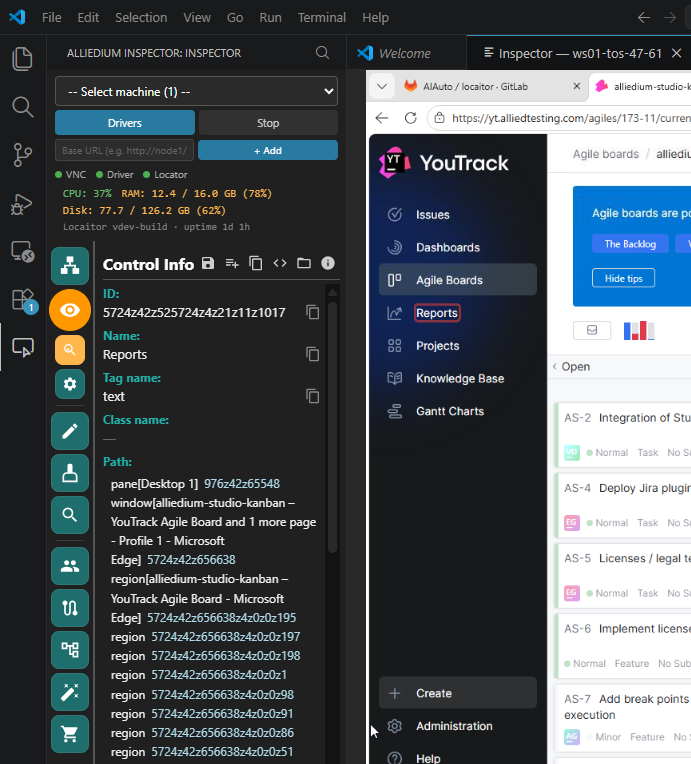
Every web developer knows their browser's element inspector. We built the same thing for native desktop apps — Windows, Java Swing, Oracle Forms, Linux GUIs — right inside VSCode. Hover, highlight, drill into the element tree, grab a stable locator in one click.
Exactly how it works in Chrome. Except it works on native Windows UI, Java Swing dialogs, Oracle Forms screens, and Linux apps too.
XPath · component metadata · OCR · image. Our multi-strategy identifier we call SmartID — stays stable when the UI shifts, backed by a 95% locator-stability track record over 2 years.
The agents use the same Inspector to decide what to click. You use it to verify their choices and debug runs. No translation layer between human and agent.
A first-class pane inside the AutoMagic VSCode plugin — not a separate tool to install, learn, or license.
Same product, same artifacts. Engineers get deeper reach, testers get automation without code, managers get a fully managed lab — everyone contributes to the same test suite.
Already have automation? AnyUIDriver plugs in to cover Windows desktop, Java, Oracle Forms, and web — all in one. LocAItor keeps your locators resilient so you stop chasing broken XPaths.
Write test cases in plain English (or keep them in TestRail). AutoMagic turns them into well-structured automated tests. You review. You approve. Done. The underlying structure is clean and readable if you ever want to dig in.
No hardware budget. No setup overhead. Your entire test environment — workstations, automation, and reporting — lives in the cloud. Spin up instantly, scale as needed, pay only for active workspaces.
We host the platform. You host everything that matters. No shared compute, no AI vendor lock-in, no data leaving your tenant.
GitHub Copilot, Claude Code, or any compatible LLM — we integrate with what you already pay for. No new AI vendor to evaluate or approve.
Every customer gets an isolated, private cloud environment. Your test data, your app screenshots, your code — stays in your dedicated space, not shared infrastructure.
Your generated tests are standard Robot Framework. The only dependency is our drivers. If you ever leave, you take almost all your automation code with you.
AI_BACKEND flag.
Per-tenant, per-tier, with onboarding and support included. Contact us for a quote.
test-tracker, test-designer,
test-debugger, test-executor)
Already running GitHub Copilot or Claude Code? We plug into what you've got. No new AI contracts, no new vendor approvals. Your key stays in your Dev Container.
All Alliedium components can run in your own infrastructure, fully air-gapped if needed — same tooling, same agents, your hardware. And if a subscription model doesn't fit your procurement, we're open to a perpetual license as an exception. Talk to us.
Talk to Us →Book a live demo. We'll run the pipeline against one of your real test cases — so you see exactly what the agents produce for your app.
Book a Demo →30 seconds. Real test. Real output.
AI_BACKEND flag. You bring
the license and the key — we don't resell AI, we integrate with
the subscription your team already pays for.
.robot files in your Git
repository. Your locators live in a PostgreSQL database you can
export. You can run the entire suite with standard Robot
Framework after we're gone. No proprietary formats, no vendor
lock-in — that's the whole point of "artifact-based."
Alliedium: Download from Remote as Git Patch). Either way, the authoritative copy lives in your repo.
Traditional automation tools produce logs. Alliedium produces artifacts — test plans, annotated screenshots, execution videos, and validation reports that let you understand, verify, and trust what the AI agent did.
Read article →Alliedium was founded by a team of test automation specialists who spent years solving the same problem across dozens of enterprise projects: the gap between manual test cases and reliable, maintainable automation is too wide, too slow to cross, and too dependent on a shrinking pool of automation engineers.
We built AutoMagic — and the cloud infrastructure around it — to close that gap entirely. Not by replacing testers, but by giving them a tool that handles the hard parts: turning plain English into structured, runnable tests; keeping those tests stable as the UI evolves; and running them on a fully managed cloud lab so teams don't have to maintain their own QA infrastructure.
Today we serve QA teams at companies of all sizes — from fast-growing software vendors to enterprise organisations with complex desktop applications that no browser-based testing tool can touch.